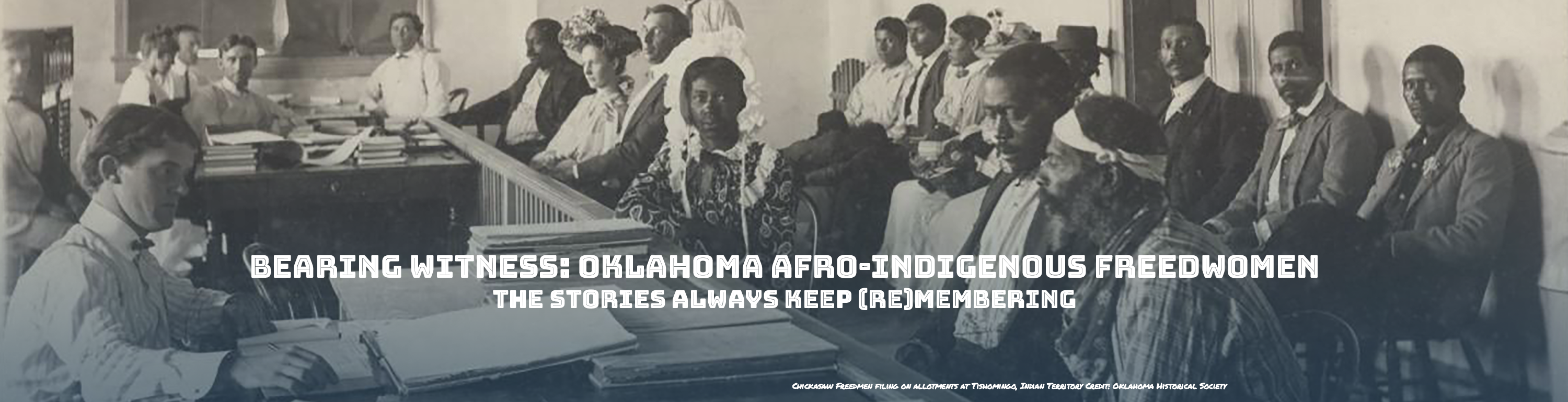
Afro-Indigenous Freedwomen
I'm leaving evidence. And you got to leave evidence too. And your children got to leave evidence....We got to burn out what they put in our minds, like you burn out a wound. Except we got to keep what we need to bear witness. That scar that's left to bear witness. We got to keep it as visible as our blood.
~Gayle Jones, Corregidora
An Invitation to Bear Witness
There is a need for greater research of the amazing history of the resilient Black people from Indian Territory. . . . It is now time to place the Freedmen back on the soil where their story has been planted. Oklahoma Freedmen and their descendants are Cherokee, Choctaw, Chickasaw, Creek, and Seminole. They are the missing part of the Oklahoma story!
~Angela Y. Walton-Raji, Oklahoma Freedmen of the Five Tribes
THIS IS AN INVITATION TO BEAR WITNESS to the (her)stories of Oklahoma Afro-Indigenous Freedwomen as central contributors to a deeper understanding of humanity and Oklahoma history. On this virtual cement wall are some of the (her)stories of Oklahoma Afro-Indigenous Freedwomen, formerly enslaved women by the Cherokee, Chickasaw, Choctaw, Muscogee (Creek), and Seminole nations in Indian Territory, modern-day Oklahoma. This interactive Restorative Healing Justice Digital Humanities Project is a virtual space created to bear witness to the gendered (her)stories of the Freedwomen and their women descendants who persevered courageously in the context of discriminatory Black codes, policies, laws, and treatment that undermined their humanity. This virtual space includes a patchwork quilt that gives testimony to their lived experiences. As we imagine just and decolonial futures, Oklahoma Afro-Indigenous Freedwomen's stories and lived experiences are essential.
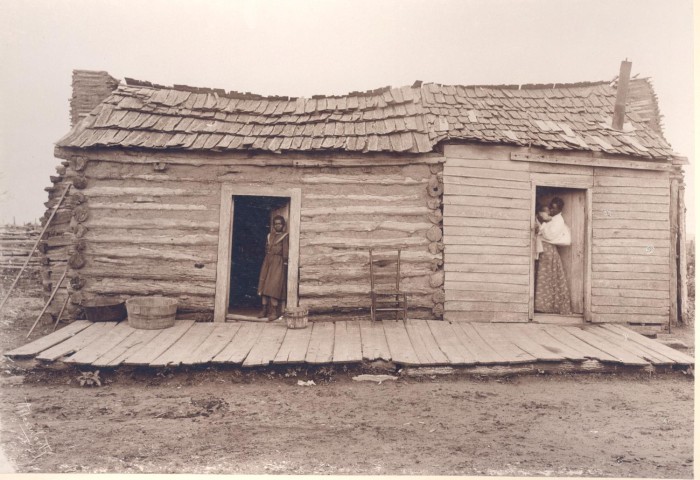
Photograph of a Freed[person] cabin in Okmulgee, Indian Territory, c. 1898-1901. Courtesy of Oklahoma Historical Society.
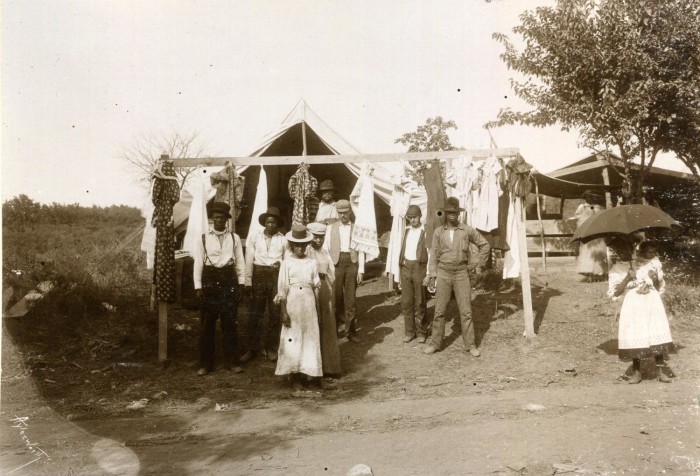
Photograph of Freed[people] at Fort Gibson for enrollment before the Dawes Commission, Fort Gibson, Indian Territory. Courtesy of Oklahoma Historical Society.
The Freedwomen narratives in this project are primarily part of the Slave Narrative Collection that include the interviews of formerly enslaved people of African descent accumulated by the Federal Writers Project of the Works Progress Administration (W.P.A.) in the 1930s. The power dynamics of the primarily white interviewers, and their tendencies to racially stereotype Freedwomen during the time period, may have caused Freedwomen to take precautions in the full expression of their sentiments. However, the W.P.A. interviews remain valuable and relevant. With this said, it is important to keep in mind that the Freedwomen interviewed have generational strategies, wisdom systems, and worldviews that shaped their lives within and beyond enslavement. The W.P.A. interviews reveal a glimpse into Freedwomen’s multilayered lived experiences, collective wisdom, and historical accounts during enslavement. The Freedwomen W.P.A. interviews also reveal gendered racial historical accounts that center the lived experiences of women and children as a significant part of their stories instead of as a marginalized side note. In the patchwork quilt of the Freedwomen's interviews, their courage and perseverance shines through the stories they share. These resilient Freedwomen in their racialized and gendered bodies bear witness to the complex world that they found themselves in while revealing Afro-Indigenous (her)stories of perseverance, courage, survival, and resistance.
The narratives shared by Freedwomen with the W.P.A. makes known the rich interrelated histories, struggles, and kinship relations between Africans and Native Americans. As Anthropologists Robert Collins (African /Choctaw descent) points out:
Between 1936 and 1938, Africans formerly enslaved by Native Americans—and the mixed-race children of enslaved Africans and Native Americans—shared with fieldworkers from the Works Progress Administration (W.P.A) what it was like to be both a slave and members of an enslaved, blended, African and Native American family. Some of these narratives, now located in the Library of Congress, describe relationships between enslaved Africans and Native American slaveholders, enslaved Africans and enslaved Native Americans, and experiences of both being abducted into slavery. ("How Africans Met Native Americans during Slavery")
These Afro-Indigenous histories and narratives reveal cross-cultural interactions, blended families, and relationship dynamics between Africans and Native Americans. The Freedwomen's narratives give credence to their distinct heritage and diverse histories across the Cherokee, Chickasaw, Choctaw, Muscogee (Creek), and Seminole nations in Indian Territory, modern-day Oklahoma. As Award Winning Journalist Toastie Oaster (Choctaw) explains, "When slavery ended in the Five Tribes after the Civil War, the formerly enslaved people became known as 'Freedmen.' They spoke tribal languages, ate tribal food, and lived in the manner of the tribes of their former owners. By any cultural metric, they were Choctaw, Chickasaw, Cherokee, Muskogee and Seminole people. The ethnic identities of the descendants of Freedmen are distinct from both African Americans and tribal members generally" (Oaster, "7 Questions ") President of the Descendants of Freedmen of the Five Civilized Tribes Association Marilyn Vann (Cherokee freedmen descendant) goes on to further explain the importance of this blended heritage: "[T]ribal identity is as important to Freedmen as Black identity" (qtd. in Oaster, "What Tribal Sovereignty"). The Freedwomen’s accounts of historical events reveals an important and unique perspective of history. As Genealogist and Historian Angela Y. Walton-Raji ( descendant of Choctaw Citizens and Enslaved Africans) points out, "Oklahoma Freedmen descendants are the largest group of Black people who have a documented tie to the five Indian tribal nations" (Oklahoma Freedmen of the Five Tribes)
The Freedwomen’s interviews shared in this project range from the ages of seventy eight to over a hundred years old. Due to enslavement, some of the Freedwomen did not know their exact date of birth. Throughout these interviews, the Freedwomen share everything from their children dying and relatives sold away to when they received their freedom. Others speak of their blended ancestry, knowing only their tribal nation's language, and being herbal practitioners for both Black and Native communities. Some share about genocidal policies enacted against Native people by the U.S. government such as the Indian Removal Act that led to what has become known as the Trail of Tears: the violent and deadly removal marches of the Cherokee, Chickasaw, Choctaw, Muskogee (Creek), and Seminole Nations from their homelands/countries to Indian Teritory, Modern Day Oklahoma. In fact, Cherokee Freedwoman Eliza Whitmire gives an historical account of the Trail of Tears that includes the enslaved while underscoring the atrocity as being “filled with horror and suffering for the unfortunate Cherokees and their slaves.” She offers a testimonial that acknowledges the unaccounted for bodies of Black and Black Native people on the Trail of Tears. In this respect, the Trail of Tears is a painful and interrelated history of Africans and Native Americans and African Native Americans.
Some Freedwomen give an account of the freedom seekers by attesting to those who ran away to the North, the women's own attempts at freedom, and their continual resistance that took on various forms. These types of testimonials in the Freedwomen's interviews establish a documented quest for freedom and a (her)story of active resistance. Some of these narratives expose Freedwomen's vulenrability as enslaved women on a settler colonial landscape, including their experiences of psychologial, physical, and emotional abuse. When we conceptualize these historical accounts of freedom seeking in relation to the Slave Revolt of 1842 in Indian Territory and the everyday resistance of freedwomen, we are able to gain a deeper understanding of the acts of survival and resistance by Freedpeople in general and Freedwomen in particular.
The Freedwomen's testimonials bear witness to what they lived through and seen as enslaved women in the Cherokee, Choctaw, Chickasaw, Muscogee (Creek), and Seminole nations. These important interviews invite reflection on the importance of reckoning with historical injustices and the impact of these histories on the health and wellness of Black, Native, and Black Native people in contemporary times. The Freedwomen's (her)stories call for deeper contemplation on Blackness, Indigeneity, gender, and interlocking oppression as well as taking action through reparative work on addressing the harm done. Thus, the Freedwomen's gendered narratives call for reckoning with the impact of how "ongoing settler colonialism divides Black and Native people by putting Blackness and Indigeneity in opposition to one another" (Tencer, "It is Complicated"). The Freedwomen's lives echoe "a constant reminder of the importance of shared history and treaty obligations" ( Roberts, "As the Country Reckons with Race"). Actualizing just and decolonial futures will require deep healing work that draws from the streams of restorative healing justice as Black, Native, and Black Native people work together for Indigenous sovereignty, Black liberation, gender equity, and healing. In the words of Scholar-Activist and Attorney Fania E. Davis, a leading national voice on restorative justice, we need
[A] restorative justice--a justice that seeks not to punish, but to heal. A justice that seeks to transform broken lives, relationships, and communities, rather than shatter them further. A justice that seeks reconciliation, rather than a deepening of conflict. A healing justice rather than a harming justice. (The Little Book of Race and Restorative Justice)
This Restorative Healing Justice Digital Humanities Project is an ongoing and living project. As a result, there will continue to be more information added, revisions, and changes made.